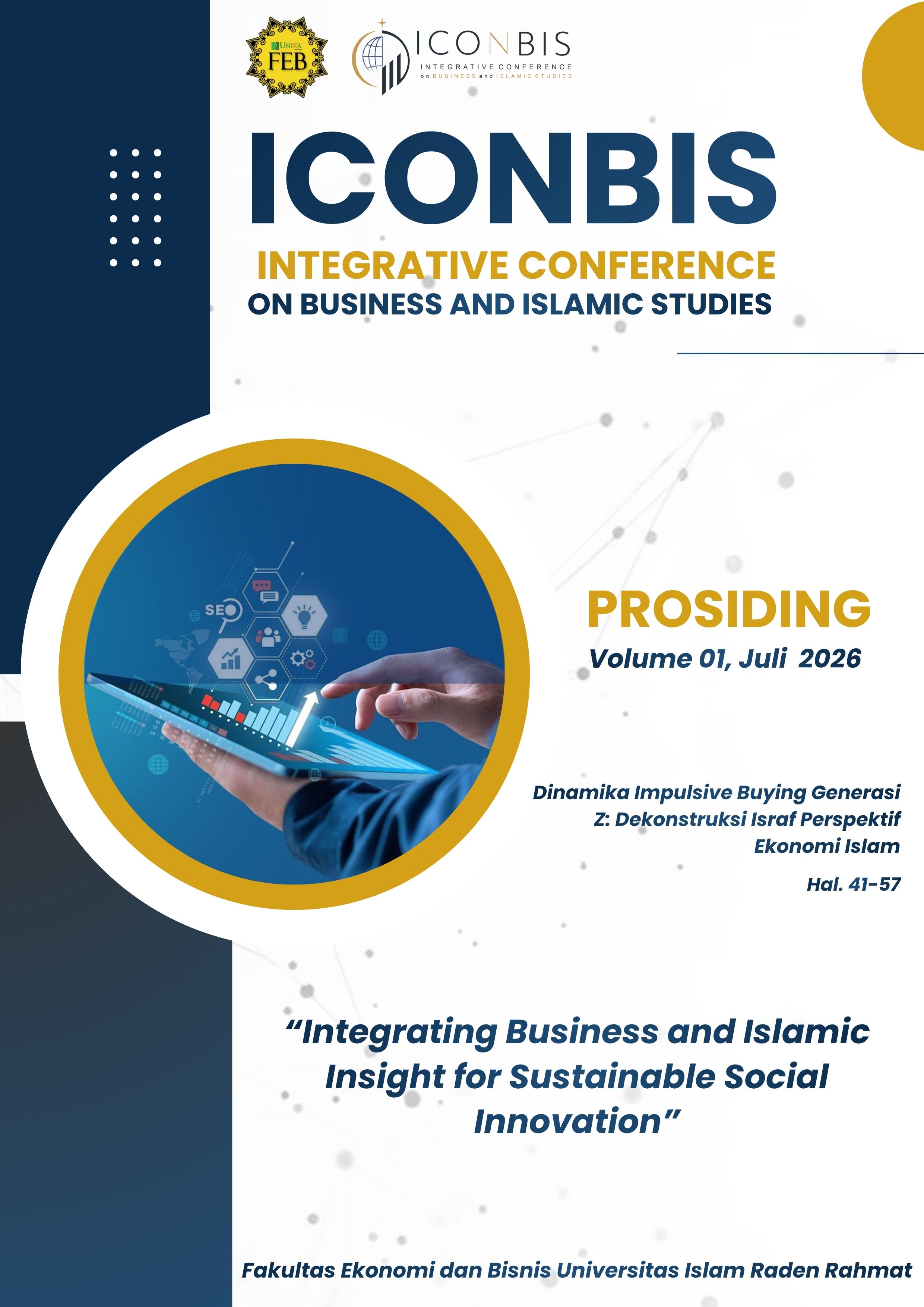
Dinamika Impulsive Buying Generasi Z: Dekonstruksi Israf Perspektif Ekonomi Islam
Kata Kunci:
impulsive buying, e-commerce, Generasi Z, israf, ekonomi perilaku IslamAbstrak
Perkembangan e-commerce mendorong perubahan pola konsumsi masyarakat, terutama pada Generasi Z yang memiliki tingkat interaksi tinggi dengan teknologi digital. Intensitas promosi digital, personalisasi algoritma, budaya viral, dan kemudahan transaksi elektronik berkontribusi terhadap munculnya perilaku impulsive buying dalam aktivitas konsumsi modern. Penelitian ini bertujuan untuk menganalisis dinamika impulsive buying pada Generasi Z serta mengkaji kecenderungannya terhadap perilaku israf dalam perspektif ekonomi perilaku Islam. Penelitian menggunakan pendekatan kualitatif deskriptif dengan metode studi literatur melalui penelaahan jurnal ilmiah, buku akademik, dan berbagai publikasi yang relevan dengan perilaku konsumsi digital, e-commerce, dan ekonomi Islam. Analisis data dilakukan menggunakan metode meta-sintesis untuk mengintegrasikan dan menginterpretasikan berbagai temuan penelitian yang berkaitan dengan hubungan antara stimulus digital, perilaku konsumsi impulsif, dan kecenderungan perilaku israf. Hasil penelitian menunjukkan bahwa impulsive buying dipengaruhi oleh stimulus visual, fear of missing out (FOMO), live shopping, serta fasilitas paylater yang mempercepat proses pengambilan keputusan pembelian. Kondisi tersebut mengindikasikan adanya pergeseran orientasi konsumsi dari pemenuhan kebutuhan menuju pencarian kepuasan emosional dan simbolik. Dalam perspektif ekonomi perilaku Islam, kecenderungan tersebut dapat mengarah pada perilaku israf karena aktivitas konsumsi tidak lagi didasarkan pada prinsip moderasi, pengendalian diri, dan kemaslahatan. Kontribusi penelitian ini terletak pada dekonstruksi pemahaman impulsive buying yang selama ini lebih banyak dijelaskan melalui perspektif pemasaran dan psikologi konsumen menjadi perspektif ekonomi perilaku Islam yang menempatkan israf sebagai konsekuensi perilaku konsumsi digital yang berlebihan. Dengan demikian, penelitian ini menawarkan kerangka konseptual yang mengintegrasikan e-commerce, impulsive buying, dan israf dalam memahami dinamika perilaku konsumsi Generasi Z di era digital..
Referensi
Abel, J., Buff, C., & Burr, S. (2016). Social media and the fear of missing out: Scale development and assessment. Journal of Business and Economics Research, 14(1), 33–44. https://doi.org/10.19030/jber.v14i1.9554
Akram, U., Hui, P., & Khan, M. K. (2021). How website quality affects online impulse buying. Asia Pacific Journal of Marketing and Logistics, 33(2), 335–354. https://doi.org/10.1108/APJML-04-20190260
Akram, U., Hui, P., Khan, M. K., Yan, C., & Akram, Z. (2021). Factors affecting online impulse buying: Evidence from Chinese social commerce environment. Sustainability, 13(2), 845.
https://doi.org/10.3390/su13020845
Al-Ghazali. (2011). Ihya Ulumuddin. Dar al-Kutub al-Ilmiyyah.
Arifianti, R., & Gunawan, D. (2023). Digital promotion and impulsive buying behavior in ecommerce marketplace. Jurnal Manajemen Bisnis, 20(2), 115–128. https://doi.org/10.31967/jmb.v20i2.512
Asosiasi Penyelenggara Jasa Internet Indonesia. (2024). Survei penetrasi internet Indonesia 2024. APJII.
Auda, J. (2008). Maqasid al-Shariah as Philosophy of Islamic Law. International Institute of Islamic Thought.
Baudrillard, J. (1998). The Consumer Society: Myths and Structures. Sage Publications.
Beatty, S. E., & Ferrell, M. E. (1998). Impulse buying: Modeling its precursors. Journal of Retailing, 74(2), 169–191. https://doi.org/10.1016/S0022-4359(99)80092-X
Blackwell, D., Leaman, C., Tramposch, R., Osborne, C., & Liss, M. (2017). Extraversion, neuroticism, attachment style and fear of missing out as predictors of social media use. Personality and
Individual Differences, 116, 69–72. https://doi.org/10.1016/j.paid.2017.04.039
Chapra, M. U. (2000). The Future of Economics: An Islamic Perspective. Islamic Foundation.
Chen, Y., & Yao, J. (2023). Algorithmic marketing and online impulse buying in e-commerce platforms. Journal of Retailing and Consumer Services, 72, 103261. https://doi.org/10.1016/j.jretconser.2023.103261
Djafarova, E., & Bowes, T. (2021). “Instagram made me buy it”: Generation Z impulse purchases in fashion industry. Journal of Retailing and Consumer Services, 59, 102345. https://doi.org/10.1016/j.jretconser.2020.102345
Dusuki, A. W. (2008). What does Islam say about corporate social responsibility? Review of Islamic Economics, 12(1), 5–28.
Fadilah, N., & Hakim, L. (2022). Perilaku konsumtif generasi muda dalam perspektif ekonomi Islam. Jurnal Ekonomi Syariah Indonesia, 12(2), 145–158.
Featherstone, M. (2007). Consumer Culture and Postmodernism. Sage Publications.
Francis, T., & Hoefel, F. (2018). True Gen: Generation Z and Its Implications for Companies. McKinsey & Company.
Fromm, J., & Read, A. (2018). Marketing to Gen Z: The Rules for Reaching This Vast and Very Different Generation of Influencers. AMACOM.
Grewal, D., Roggeveen, A. L., & Nordfält, J. (2020). The future of retailing. Journal of Retailing, 96(1), 1–6. https://doi.org/10.1016/j.jretai.2020.02.008
Hart, C. (1998). Doing a Literature Review: Releasing the Social Science Research Imagination. Sage Publications.
Hidayat, F., Prasetyo, A., & Maulana, R. (2023). Social media influence and consumer impulsive buying behavior in online shopping. Jurnal Ilmu Manajemen dan Bisnis, 11(3), 201–214. https://doi.org/10.17509/jimb.v11i3.59821
Hidayat, S., & Rafiki, A. (2020). The influence of digital consumption on Muslim consumer behaviour. Journal of Islamic Marketing, 11(6), 1523–1538. https://doi.org/10.1108/JIMA-09-2018-0167
Huang, M.-H., & Rust, R. T. (2021). A strategic framework for artificial intelligence in marketing. Journal of the Academy of Marketing Science, 49(1), 30–50.
Islahi, A. A. (2014). Economic Thinking of Classical Muslim Scholars. Islamic Economics Research Center.
Islam, T., & Chandrasekaran, U. (2021). Social media influence on impulsive buying behaviour in digital commerce. International Journal of Consumer Studies, 45(5), 1121–1138. https://doi.org/10.1111/ijcs.12667
Kahf, M. (1995). The Islamic Economy: Analytical Study of the Functioning of the Islamic Economic System. Plainfield.
Kaur, P., Dhir, A., & Rajala, R. (2020). Assessing flow experience in social commerce. Computers in Human Behavior, 113, 106487. https://doi.org/10.1016/j.chb.2020.106487
Kotler, P., & Keller, K. L. (2016). Marketing Management. Pearson Education.
Lamis, S. F., Handayani, P. W., & Fitriani, W. R. (2022). Impulse buying during flash sales in the online marketplace. Cogent Business & Management, 9(1), 2068402. https://doi.org/10.1080/23311975.2022.2068402
Laudon, K. C., & Traver, C. G. (2021). E-Commerce 2021: Business, Technology, Society (17th ed.). Pearson.
Libert, B., Beck, M., & Wind, Y. (2020). The Network Imperative: How to Survive and Grow in the Age of Digital Business Models. Harvard Business Review Press.
Lim, S. M., Lee, H. J., & Kim, J. W. (2022). Consumer impulsive buying behavior in digital commerce environment. Sustainability, 14(9), 5124. https://doi.org/10.3390/su14095124
Lim, X., Mohd Radzol, A. Z., Cheah, J.-H., & Wong, M. W. (2022). The impact of social media influencers on purchase intention and the mediation effect of customer attitude. Asian Journal of Business Research, 12(2), 19–36. https://doi.org/10.14707/ajbr.220120
Liu-Thompkins, Y. (2019). A decade of online advertising research. International Journal of
Advertising, 38(3), 1–13. https://doi.org/10.1080/02650487.2018.1483214
Mannan, M. A. (1997). Islamic Economics: Theory and Practice. Hodder and Stoughton.
Naqvi, S. N. H. (2003). Ethics and Economics: An Islamic Perspective. Islamic Foundation.
Nasrullah, M., & Ismail, A. (2021). Digital consumption and consumer culture in Islamic economic perspective. Journal of Islamic Economic Studies, 13(2), 115–128. https://doi.org/10.35329/jies.v13i2.2451
Pantano, E., & Gandini, A. (2018). Exploring the forms of sociality mediated by innovative e-
commerce platforms. Journal of Retailing and Consumer Services, 44, 51–56. https://doi.org/10.1016/j.jretconser.2018.06.001
Perry, A. (2002). Meta-Synthesis Method for Qualitative Research. Sage Publications.
Przybylski, A. K., Murayama, K., DeHaan, C. R., & Gladwell, V. (2013). Motivational, emotional, and behavioral correlates of fear of missing out. Computers in Human Behavior, 29(4), 1841–1848.
https://doi.org/10.1016/j.chb.2013.02.014
Qardhawi, Y. (1997). Norma dan Etika Ekonomi Islam. Gema Insani Press.
Ramadhan, R., & Prasetyo, B. (2023). Live commerce, social media trends, and impulsive buying behavior among Generation Z. Jurnal Ilmu Ekonomi dan Bisnis Islam, 5(1), 55–70. https://doi.org/10.24239/jiebi.v5i1.158
Rook, D. W., & Fisher, R. J. (1995). Normative influences on impulsive buying behavior. Journal of Consumer Research, 22(3), 305–313. https://doi.org/10.1086/209452
Sari, N., & Nugroho, R. (2024). Flash sale, paylater, and impulsive buying behavior in digital marketplace. Jurnal Riset Ekonomi dan Bisnis Digital, 5(1), 44–60. https://doi.org/10.55927/jrebd.v5i1.7712
Schwieger, D., & Ladwig, C. (2018). Reaching and retaining the next generation: Adapting to the expectations of Gen Z in the classroom. Information Systems Education Journal, 16(3), 45–54.
Setiawan, D., & Muslikhati. (2022). Islamic behavioral economics perspective on digital consumption and self-control. Jurnal Ekonomi Syariah Teori dan Terapan, 9(3), 233–247. https://doi.org/10.20473/vol9iss20223pp233-247
Siswanto. (2010). Systematic review sebagai metode penelitian untuk mensintesis hasil-hasil penelitian. Buletin Penelitian Sistem Kesehatan, 13(4), 326–333. https://doi.org/10.22435/bpsk.v13i4
Sokolova, K., & Kefi, H. (2020). Instagram and YouTube bloggers promote it, why should I buy?
How credibility and parasocial interaction influence purchase intentions. Journal of Retailing and Consumer Services, 53, 101742. https://doi.org/10.1016/j.jretconser.2019.01.011
Sun, Y., Shao, X., Li, X., Guo, Y., & Nie, K. (2019). How live streaming influences purchase intentions in social commerce. Electronic Commerce Research and Applications, 37, 100886. https://doi.org/10.1016/j.elerap.2019.100886
Turner, A. (2015). Generation Z: Technology and Social Interest. Common Ground Publishing.
Utami, C. W., & Sumaryono. (2020). Digital consumer behavior and impulsive buying in Indonesian marketplace. Jurnal Manajemen dan Kewirausahaan, 22(2), 145–156. https://doi.org/10.9744/jmk.22.2.145-156
Verplanken, B., & Herabadi, A. (2001). Individual differences in impulse buying tendency. European Journal of Personality, 15(S1), S71–S83. https://doi.org/10.1002/per.423
Wongkitrungrueng, A., & Assarut, N. (2020). The role of live streaming in building consumer trust and engagement. Journal of Business Research, 117, 543–556. https://doi.org/10.1016/j.jbusres.2018.08.032
Zheng, X., Men, J., Yang, F., & Gong, X. (2019). Understanding impulse buying in mobile commerce: An investigation into hedonic and utilitarian browsing. International Journal of Information
Management, 48, 151–160. https://doi.org/10.1016/j.ijinfomgt.2019.02.010 Zuboff, S. (2019). The Age of Surveillance Capitalism. PublicAffairs.
Unduhan
Diterbitkan
Terbitan
Bagian
Lisensi
Hak Cipta (c) 2026 Nanda Rizky Lestiono, Zubdhatul waidzin, Fajar Sodik, Lailatul Sa’diyah

Artikel ini berlisensiCreative Commons Attribution-NonCommercial-ShareAlike 4.0 International License.