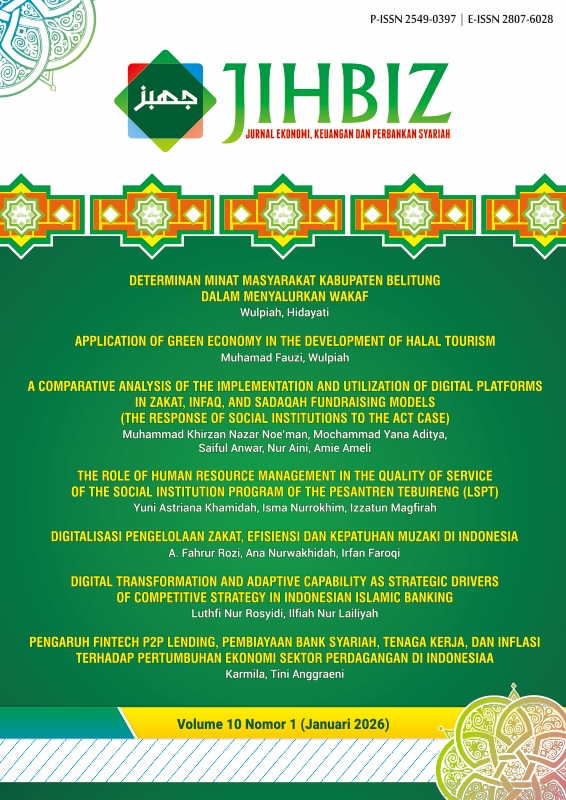
Digital Transformation and Adaptive Capability as Strategic Drivers of Competitive Strategy in Indonesian Islamic Banking
DOI:
https://doi.org/10.33379/jihbiz.v10i1.8996Keywords:
digital transformation, adaptive capability, competitive strategy, Islamic banking, PLS-SEM, IndonesiaAbstract
This study examines the influence of digital transformation and adaptive capability on competitive strategy in Indonesian Islamic banks operating in an increasingly dynamic and digitalized financial environment. Using a quantitative approach, data were collected from Islamic banking practitioners involved in strategic and digital initiatives and analysed through Partial Least Squares Structural Equation Modelling (PLS-SEM). The results demonstrate that digital transformation has a significant positive effect on both adaptive capability and competitive strategy while adaptive capability also exerts a significant influence on competitive strategy, indicating its critical role as a strategic enabler. The findings highlight that adaptive capability allows Islamic banks to translate digital investments into effective competitive positioning by enhancing agility, innovation and resilience amid technological disruption and regulatory complexity. This study contributes to the Islamic banking and strategic management literature by offering an integrative model that links digital transformation, adaptive capability and competitive strategy and provides practical insights for managers seeking to strengthen long-term competitiveness in Sharia-compliant financial institutions.
Downloads
Published
Issue
Section
License
Copyright (c) 2026 Jihbiz : Jurnal Ekonomi, Keuangan dan Perbankan Syariah

This work is licensed under a Creative Commons Attribution-NonCommercial 4.0 International License.
Ownership Obligation: Islamic Economics and Islamic Banking Studies Program Universitas Islam Raden Rahmat as organizer/owner/party who has the right/authority to publish research results.

 English
 Indonesia