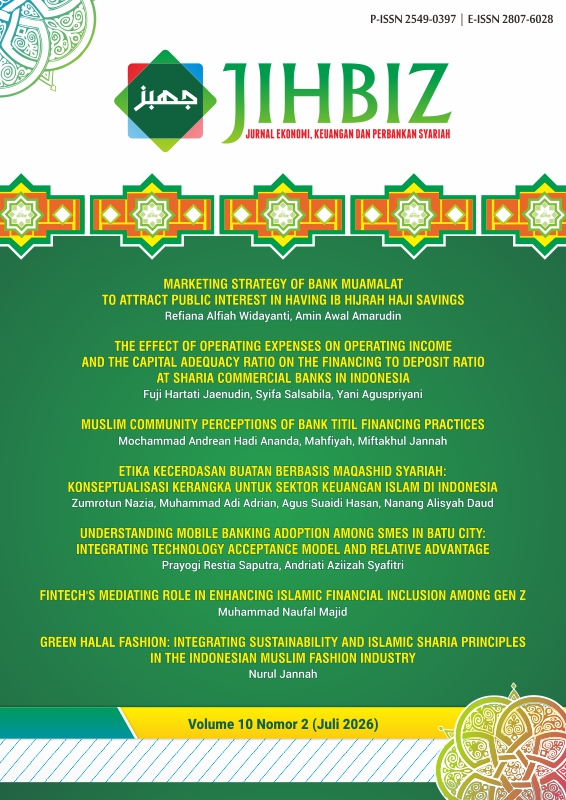
The Effect of Operating Expenses on Operating Income and the Capital Adequacy Ratio on the Financing to Deposit Ratio at Sharia Commercial Banks in Indonesia
DOI:
https://doi.org/10.33379/jihbiz.v10i2.10124Keywords:
BOPO, CAR, STATA, financing to deposit ratio, Islamic commercial banksAbstract
This study aims to analyze the effect of Operating Costs to Operating Income (BOPO) and the Capital Adequacy Ratio (CAR) on the Financing to Deposit Ratio (FDR) of Islamic Commercial Banks in Indonesia during the 2021–2025 period. The study uses an associative quantitative approach utilizing quarterly time series data obtained from Islamic Banking Statistics published by the Financial Services Authority. Data analysis was performed using multiple linear regression using STATA software, with the Cochrane-Orcutt method applied to address autocorrelation. The results reveal three main findings. First, BOPO has a negative and significant effect on FDR at the 10% significance level. This indicates that increased operating expenses can limit banks' ability to disburse financing. Second, CAR has no significant effect on FDR. This finding indicates that a high level of capital adequacy does not directly drive increased financing, reflecting banks' prudent attitude in the post-pandemic period. Third, BOPO and CAR simultaneously have a significant effect on FDR. Based on these results, this study concludes that operational efficiency has a more dominant role in explaining the intermediation function of Islamic Commercial Banks compared to capital adequacy.
Downloads
Published
Issue
Section
License
Copyright (c) 2026 Jihbiz : Jurnal Ekonomi, Keuangan dan Perbankan Syariah

This work is licensed under a Creative Commons Attribution-NonCommercial 4.0 International License.
Ownership Obligation: Islamic Economics and Islamic Banking Studies Program Universitas Islam Raden Rahmat as organizer/owner/party who has the right/authority to publish research results.

 English
 Indonesia