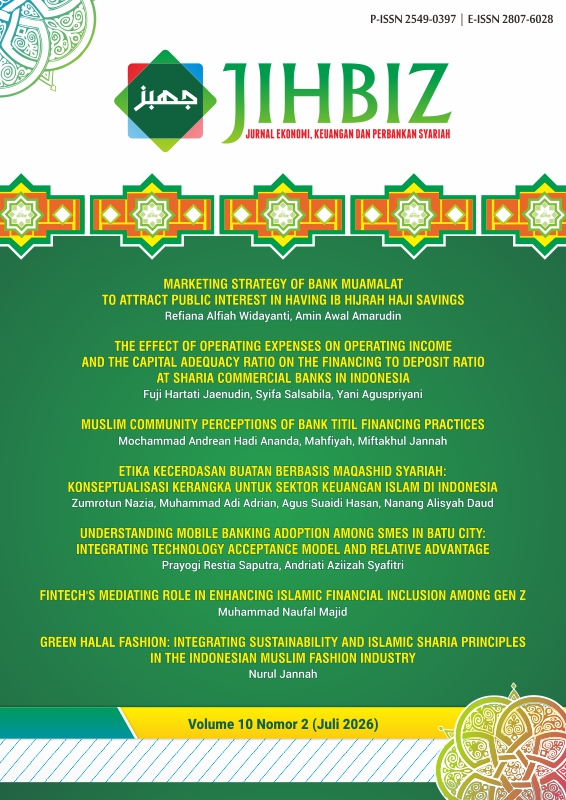
Ethics of Artificial Intelligence Based on Maqashid Syariah: Conceptualization of a framework for the Islamic Financial Sector in Indonesia
DOI:
https://doi.org/10.33379/jihbiz.v10i2.9987Keywords:
Artificial Intelligence (AI), Islamic Finance, maqashid shariaAbstract
The development of artificial intelligence (AI) in Indonesia's Islamic finance sector offers efficiency, financial inclusion, and strengthened regulatory compliance, but also raises ethical issues, algorithmic bias, and sharia compliance. This article aims to formulate an AI ethics framework based on maqashid al-shariah to serve as a reference for sustainable AI governance in Islamic banking and finance. The method used is a systematic literature review of reputable indexed articles discussing Islamic AI ethics, maqashid al-shariah, and the application of AI in Indonesian Islamic finance. The results of the study indicate that the dimensions of hifz al-din, al-nafs, al-aql, al-nasl, and al-mal can be operationalized into the principles of transparency, accountability, justice, data protection, and public interest orientation in AI design and supervision. The recommendations from this study are to propose a conceptual framework that integrates maqashid al-syariah with a modern AI risk governance model, as well as recommending strengthening regulations, the role of the DPS, and AI ethics literacy in Indonesian Islamic financial institutions.
Downloads
Published
Issue
Section
License
Copyright (c) 2026 Jihbiz : Jurnal Ekonomi, Keuangan dan Perbankan Syariah

This work is licensed under a Creative Commons Attribution-NonCommercial 4.0 International License.
Ownership Obligation: Islamic Economics and Islamic Banking Studies Program Universitas Islam Raden Rahmat as organizer/owner/party who has the right/authority to publish research results.

 English
 Indonesia