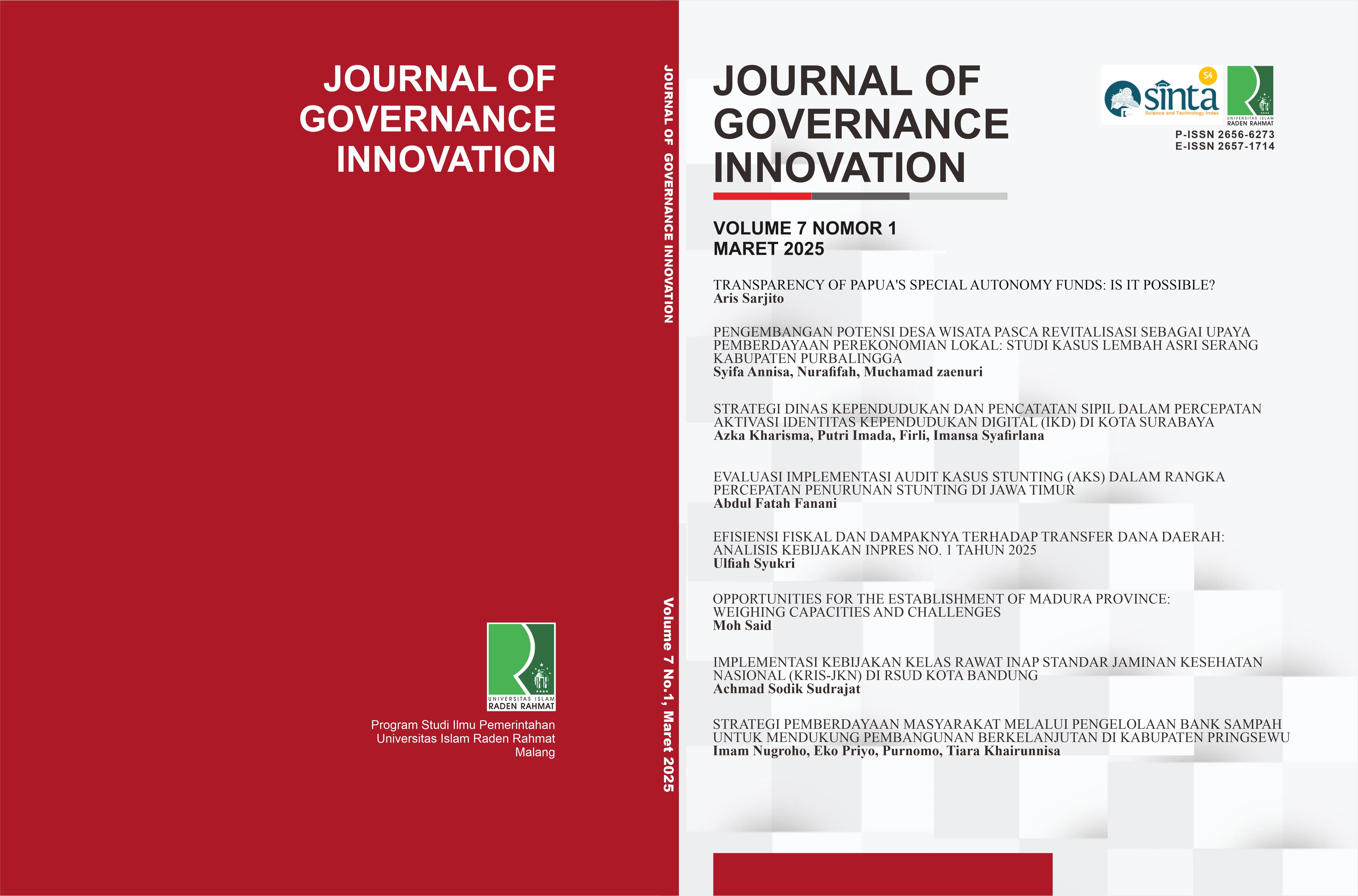
The Opportunities for the Establishment of Madura Province: Weighing Capacities and Challenges
DOI:
https://doi.org/10.36636/jogiv.v7i1.6765Keywords:
Capacities, Challenges, New Autonomous Region, Madura ProvinceAbstract
This paper describes the opportunities for the establishment of Madura Province through an analysis of the capacities and challenges. The analysis is carried out on regional economy quality, equitable development, human resources quality, village development, fiscal capacity, and regional fiscal independence. Expanding regions or creating New Autonomous Regions is frequently the approach taken to enhance governance quality in the regions. Therefore, understanding the scope of the opportunities is crucial. The deepening of opportunities is achieved by analysing the capacities and challenges present in the new regional government. The results, it is known that the regencies on Madura Island have several advantages and challenges. The advantage is having GINI Index, HDI, and IDM that are on average with regencies/cities in East Java. Meanwhile, the challenge is the quality of the regional economy as indicated by the GRDP, that is far below the regencies/cities in East Java. The following challenge is the region's limited capacity and fiscal independence. Compared to the values of other regencies/cities in East Java, the capacity and fiscal independence of the four regencies on Madura Island are still below average. However, the quality of human resources, development, and existing equity can serve as the fundamental capital to maximize the management of the potential that is owned, if granted to become a province. Madura Island has sufficient natural resources and economic potential, with more authority, can be maximized and used to raise the standard of public services and governance, which will benefit the local society.
References
Azwar, S. (2007). Metode Penelitian. Yogyakarta: Pustaka Pelajar.
Bappenas, and UNDP. (2008). Studi Evaluasi Dampak Pemekaran Daerah 2001- 2007. BRIDGE (Building and Reinventing Decentralised Governance).
Fenwick, J., and Bailey, M. (1999). Local Government Reorganisation in the UK: Decentralisation or Corporatism? International Journal of Public Sector Management, 12(3), 249-261.
Finaldi, Z. (2022). Ini Dia 9 Calon Provinsi Baru di Pulau Jawa, dari Provinsi Bogor Raya di Jabar Hingga Blambangan di Jatim. (kabar-priangan.com, 7 Februari 2022).
Halim. A. (2007). Akuntansi Keuangan Daerah. Jakarta: Salemba Empat.
Handayani, T. U., and Erinos, N. R. (2020). Pengaruh Pendapatan Asli Daerah dan Belanja Modal terhadap Tingkat Kemandirian Keuangan Daerah dengan Pertumbuhan Ekonomi sebagai Variabel Moderating. Jurnal Eksplorasi Akuntansi, 2(1), 2348-2361.
Hehamahua, H. (2015). Impact Analysis of the Village Fund Allocation (ADD) Toward Economic Community (Case Study on the Rural District of Namlea Siahoni), Buru Regency. Journal of Social and Development Sciences.Vol. 6 No. 3 pp 15-23 ISSN 2221-1152.
Hwang-sun Kang. 2003. Efficiency. Dalam J. Rabin, (ed). Encyclopedia of Public Administration and Public Policy. New York: Marcel Dekker, Inc.
Kustianingsih, N., Muslimin, and Kahar, A. (2018). Pengaruh Pendapatan Asli Daerah (PAD), Dana Alokasi Umum (DAU), Dana Alokasi Khusus (DAK) Terhadap Tingkat Kemandirian Daerah Pada Pemerintah Daerah Kabupaten Kota di Provinsi Sulawesi Tengah, Katalogis, 6(6), pp. 82–91.
Lewis, P., and Smoke, B. D. (1996). Fiscal Decentralization in Indonesia: A new Approach to An old Idea. World Development, Volume 24, Issue 8, August 1996, Pages 1281-1299.
Mahsun, M. (2006). Pengukuran Kinerja Sektor Publik. Yogyakarta: BPFE.
Mantelan, V. (2022). Pembentukan 3 Provinsi Baru di Papua untuk Siapa? (Kompas.com, 15 April 2022). https://nasional.kompas.com/read/2022/04/15/07150951/pembentukan-3-provinsi-baru-di-papua-untuk-siapa?page=all
Martinez-Vazquez, J. and Vaillancourt, F. (2011). Obstacles to Decentralisation: Lessons from the Developing World. Decentralisation in Developing Countries: Global Perspectives on the Obstacles to Fiscal Devolution, Issue September, 1-13.
Muluk, M.R.K. (2009). Peta Konsep Desentralisasi dan Pemerintahan Daerah. Surabaya; ITS Press.
Oates, W.E. (1972). Fiscal Federalism. New York: Harcourt Brace Jovanovich.
Rachman, A. A. (2011). Administrasi Pemerintahan Dalam Pembangunan. Jakarta: CV. Haji Mas Agung.
Said, M. (2008). Arah Baru Otonomi Daerah di Indonesia. Malang: UMM Press.
Siregar, B., and Pratiwi, N. (2017). The Effect of Local Government Characteristics and Financial Independence on Economic Growth and Human Development Index in Indonesia. Jurnal Manajemen Dan Kewirausahaan, 19(2), 65–71. https://doi.org/10.9744/jmk.19.2.65-71.
Smith, B.C. (1985). Decentralization: The Territorial Dimention of the State. George Allen & Unwin.
Smoke P, and Loffler, G. (2013). Literature review on the role of decentralization/devolution in improving development outcomes at the local level. Report for UK Department for International Development.
Susilawati, D., Kusumastuti, L. W., and Rahmawati, I. F. (2018). Menilai Kinerja Keuangan dengan Analisis Rasio Keuangan: Studi Kasus BKAD Sleman. Jati: Jurnal Akuntansi Terapan Indonesia, 1(2), 91–98. https://doi.org/10.18196/jati.010210
Tiebout, C. M. (1956). A Pure Theory of Local Expenditures. The Journal of Political Economy, Vol. 64, No. 5, (Oct., 1956), pp. 416-424 http://www.jstor.org/stable/1826343.
Downloads
Published
Issue
Section
License
Copyright (c) 2025 Moh Said

This work is licensed under a Creative Commons Attribution-ShareAlike 4.0 International License.
The author who wishes to publish articles in this journal agree with the following conditions:
- Author retains the copyright and simultaneously provides the journal the first publishing rights of the manuscript under a Creative Commons Attribution License that allows others to share the work with an initial job writing and publishing statement in this journal.
- The author can include in separate additional contractual arrangements for the rich version of non-exclusive distribution of journal publications (eg posting it to the institutional repository or publishing it in a book), with recognition of publishing initially in this journal.
- The author is permitted and encouraged to post their work online (for example: in the institutional repository or on their website) before and during the submission process because it can lead to productive exchanges, as well as earlier and more powerful citations of published works. (See open access policy).