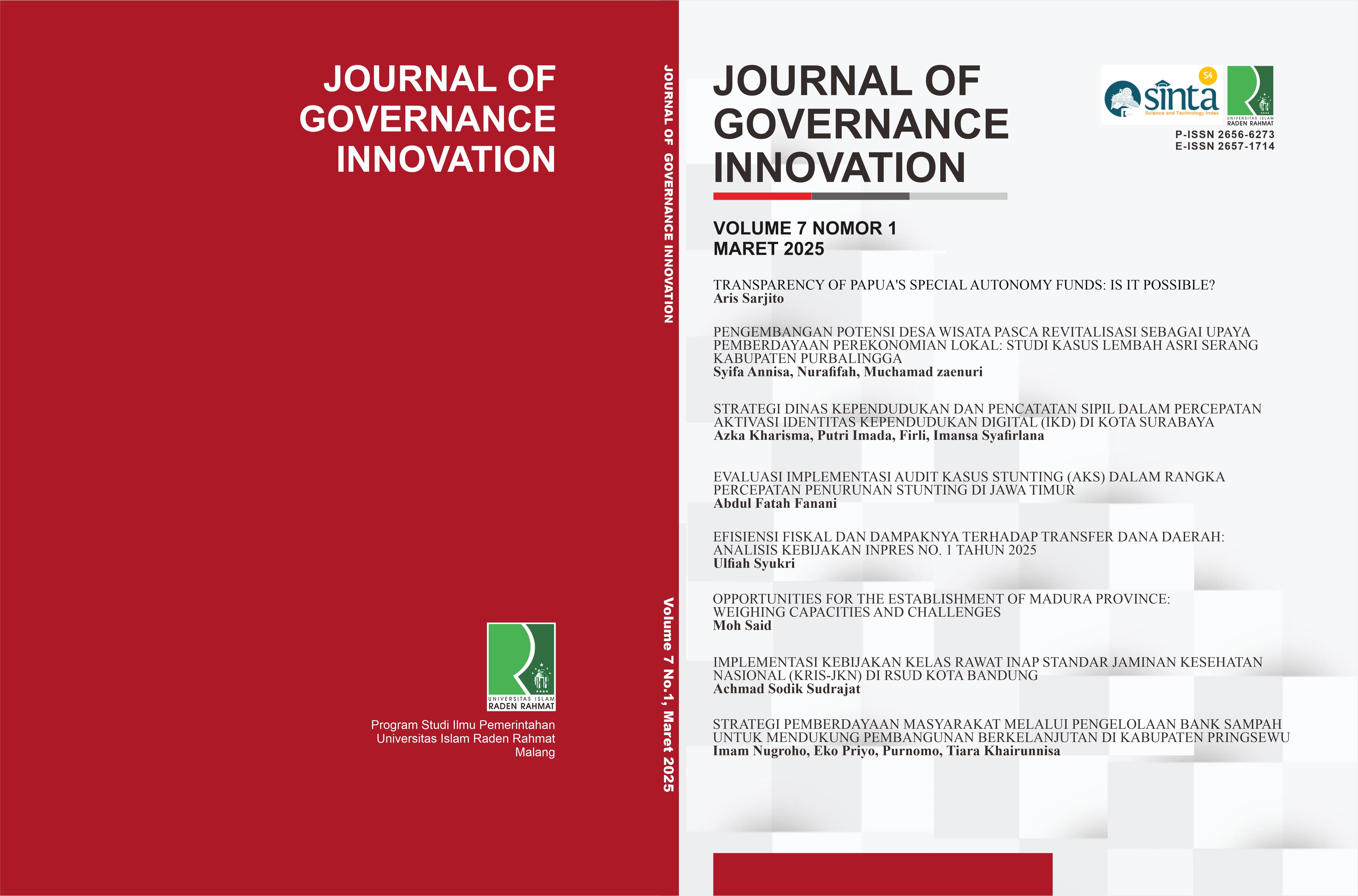
Evaluasi Implementasi Audit Kasus Stunting (AKS) Dalam Rangka Percepatan Penurunan Stunting di Jawa Timur
DOI:
https://doi.org/10.36636/jogiv.v7i1.6882Keywords:
Stunting, Audit Kasus Stunting, Evaluasi Kebijakan, Percepatan Penurunan StuntingAbstract
Stunting Case Audit (AKS) is a strategic intervention under the national policy to accelerate stunting reduction in Indonesia. Its implementation at the regional level requires comprehensive evaluation. This study aims to assess the implementation of AKS in East Java Province based on the perspectives of implementers at various levels of government. A descriptive quantitative approach was employed, involving 743 respondents comprising members of Village/Kelurahan TPPS, Sub-district TPPS, District/City TPPS, Technical Teams, Expert Teams, and the Stunting Task Force. Data were collected through an online questionnaire and analyzed using descriptive statistics with the assistance of SPSS. The evaluation was guided by the Input-Process-Output model and the "5 PASTI" framework. The study found that most regions had established regulations and institutional structures for AKS. The level of support from the Stunting Reduction Acceleration Teams (TPPS) at all levels was rated high, and the overall quality of AKS implementation was considered good. However, gaps were identified in the availability and understanding of the AKS pocketbook, inconsistency in auditee selection, and uneven follow-up of AKS results. Most respondents acknowledged that AKS is highly beneficial and should be continued. The implementation of AKS in East Java has been fairly effective, though it requires strengthening in technical understanding, dissemination of guidelines, and utilization of audit results in policymaking. Recommendations focus on enhancing implementers’ capacity, optimizing interventions, and expanding multisectoral funding.
Keywords: Stunting, Stunting Case Audit, Policy Evaluation, Stunting Reduction Acceleration.
References
Agustino, L. (2008). Dasar-dasar kebijakan publik. Bandung: Alfabeta.
Ardiana, I., Elviana, A., Murniati, C., & Nafsi, I. (2022). Buku Saku Audit Kasus Stunting. Direktorat Bina Keluarga Balita Dan Anak BKKBN, 1–456.
Muscat, D. M., Ayre, J., Nutbeam, D., Harris, A., Tunchon, L., Zachariah, D., & McCaffery, K. J. (2020). Embedding a Health Literacy Intervention Within Established Parenting Groups: An Australian Feasibility Study. Health Literacy Research and Practice, 4(1), e67–e78. https://doi.org/10.3928/24748307-20200217-01
Nirmalasari, N. O. (2020). Stunting Pada Anak : Penyebab dan Faktor Risiko Stunting di Indonesia. Qawwam: Journal For Gender Mainstreming, 14(1), 19–28. https://doi.org/10.20414/Qawwam.v14i1.2372
Perpres No. 72 Tahun 2021. (2021). Peraturan presiden Republik Indonesia Nomor 72 Tahun 2021 Tentang Percepatan Penurunan Stunting. In Lembaran Negara RI (Issue 1, pp. 1–75).
Phitra, F. A., Lipoeto, N. I., & Yetti, H. (2023). Evaluasi Pelaksanaan Program Pencegahan Dan Penurunan Stunting Di Desa Lokus Stunting Kabupaten Merangin Tahun 2022. Jurnal Kebijakan Kesehatan Indonesia, 12(3), 127. https://doi.org/10.22146/jkki.85424
Sugiyono. (2018). Metode Penelitian Kuantitatif. Alfabeta.
Sugiyono, P. D. (2019). Metode Penelitian Kuantitatif Kualitatif dan R&D (M. Dr. Ir. Sutopo. S. Pd. ALFABETA, Cv.
Sulistyawati, W., Wahyudi, & Trinuryono, S. (2022). Analisis (Deskriptif Kuantitatif) Motivasi Belajar Siswa Dengan Menggunakan Model Pembelajaran Blended Learning Saat Pandemi Covid-19 (Deskriptif Kuantitatif Di Sman 1 Babadan Ponorogo). KadikmA, 13(1), 68. https://doi.org/10.19184/kdma.v13i1.31327
Syafrawati, S., Lipoeto, N. I., Masrul, M., Novianti, N., Gusnedi, G., Susilowati, A., Nurdin, A., Purnakarya, I., Andrafikar, A., & Umar, H. B. (2023). Factors driving and inhibiting stunting reduction acceleration programs at district level: A qualitative study in West Sumatra. PLoS ONE, 18(3 MARCH), 1–21. https://doi.org/10.1371/journal.pone.0283739
Trihono, Tjandrarini, D. H., Irawati, A., Utami, N. H., Tejayanti, T., & Nurlinawati, I. (2015). Pendek (Stunting) di Indonesia, Masalah dan Solusinya (M. Sudomo (ed.)). Lembaga Penerbit Badan Penelitian dan Pengembangan Kesehatan.
William N. Dunn. (2003). Pengantar Analisis Kebijakan Publik (M. Darwin (ed.); Edisi 2). Gajah Mada University Press.
Downloads
Published
Issue
Section
License
Copyright (c) 2025 Abdul Fatah Fanani

This work is licensed under a Creative Commons Attribution-ShareAlike 4.0 International License.
The author who wishes to publish articles in this journal agree with the following conditions:
- Author retains the copyright and simultaneously provides the journal the first publishing rights of the manuscript under a Creative Commons Attribution License that allows others to share the work with an initial job writing and publishing statement in this journal.
- The author can include in separate additional contractual arrangements for the rich version of non-exclusive distribution of journal publications (eg posting it to the institutional repository or publishing it in a book), with recognition of publishing initially in this journal.
- The author is permitted and encouraged to post their work online (for example: in the institutional repository or on their website) before and during the submission process because it can lead to productive exchanges, as well as earlier and more powerful citations of published works. (See open access policy).