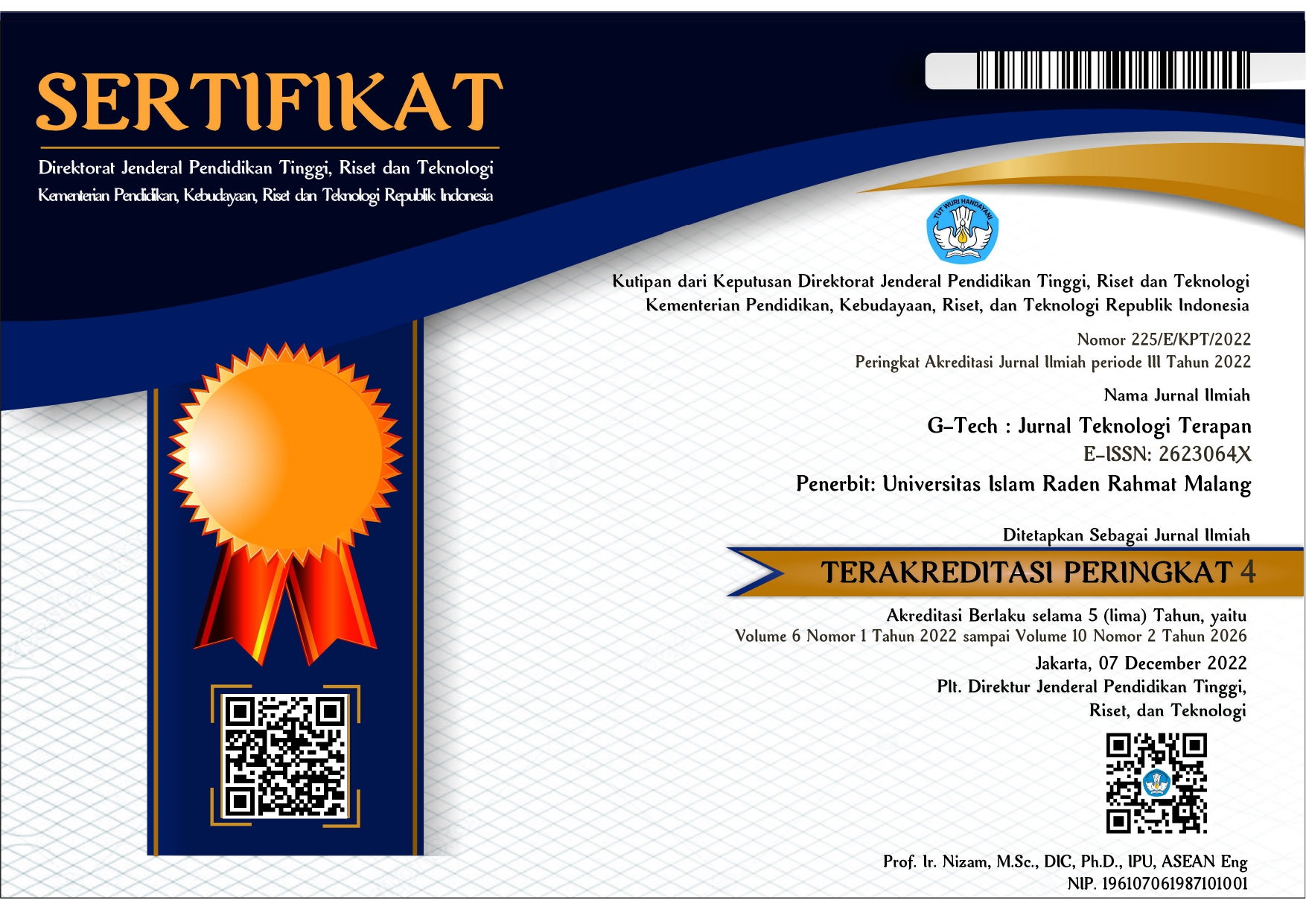
Investigasi Kesenjangan Pengguna Instant Messenger Ditinjau dari Aspek Desain User Interface dan Teknologi
DOI:
https://doi.org/10.33379/gtech.v7i4.3355Keywords:
Instant messenger, WhatsApp, Telegram, User InterfaceAbstract
With the development of instant messenger applications, people began to abandon SMS. This phenomenon has become a momentum for instant messenger application developers to offer features with the latest technology, with the aim of attracting user attention. However, performance improvements are not always in accordance with user needs. In fact, many users prefer instant messenger applications that have standard features. This research discusses the factor analysis of a person in determining the instant messenger application used. The analysis process is carried out by comparing two main variables, namely user interface design and technology used. Data collection was carried out by distributing questionnaires and conducting deep interviews with 80 respondents. The results of this research indicate that user interface design is the main factor in determining a person's use of instant messenger applications.
References
Ghazali, N., & Razali, R. (2014). A preliminary review of interface design elements for mobile electronic government systems. 2014 4th World Congress on Information and Communication Technologies, WICT 2014, 217–223. https://doi.org/10.1109/WICT.2014.7076908
H Delam, & Eidi A. (2020). WhatsApp Messenger role in Coronavirus Disease 2019 (COVID 19) Pandemic. Journal of Health Sciences & Surveillance System, 8(4).
Ikhlas, Z., & Mahmud, M. (2012). Mobile Interface for m-Government Services: A Framework for Information Quality Evaluation. International Journal of Scientific & Engineering Research, 3(8), 1–5.
Jogiyanto. (2011). Konsep dan aplikasi structural equation modeling berbasis varian dalam penelitian bisnis. UPP STIM YKPN.
Molina, O. E. (2022). The Effects of WhatsApp and Telegram on Student Engagement: An Analysis from the Mixed-Methods Approach. Education Research International, 2022. https://doi.org/10.1155/2022/2881404
Muhammad, A., Hanggara, B. T., & Muslimah Az-Zahra, H. (2022). Analisis Perbandingan Pengalaman Pengguna Aplikasi Whatsapp dan Telegram menggunakan Kuesioner Mecue (Vol. 6, Issue 1). http://j-ptiik.ub.ac.id
Priyadarsini, N., Venkata, S., Sai, S., & Palisetti, K. (2022). Comparative research of WhatsApp and Telegram by using heuristic principles. www.bth.se
Ridwan Mustajab. (2023, February 10). WhatsApp Masih menjadi instan messege favorit di Indonesia. Https://Dataindonesia.Id/Internet/Detail/Whatsapp-Masih-Menjadi-Media-Sosial-Terfavorit-Di-Indonesia.
Rogers, E. M. (2003). Diffusion of Innovations, 5th Edition. In E. M. Rogers (Ed.), Book (5th ed.). The Free Press.
Sari-Motlagh, R., Ebrahimi, S., Nikfallah, A., Hajebrahimi, S., & Shakiba, B. (2016). Lifelong Learning in Practice: The Age of Discussion through Social Media. European Urology, 69(6), 1162–1163. https://doi.org/10.1016/j.eururo.2016.01.046
Shahrul, A., & Wibawa, A. P. (2021). Choosing an Instant Messaging App: Security or Convenience? Comparison between Whatsapp and Telegram. Buletin Ilmiah Sarjana Teknik Elektro, 3(2), 115–121. https://doi.org/10.12928/biste.v3i2.2784
Sutikno, T., Handayani, L., Stiawan, D., Riyadi, M. A., & Subroto, I. M. I. (2016). WhatsApp, viber and telegram: Which is the best for instant messaging? International Journal of Electrical and Computer Engineering, 6(3), 909–914. https://doi.org/10.11591/ijece.v6i3.10271
Yasraf Amir Piliang. (2011). Dunia yang dilipat : Tamasya Melampaui Batas-Batas Kebudayaan. Matahari.
Yu, N., & Kong, J. (2016). User experience with web browsing on small screens: Experimental investigations of mobile-page interface design and homepage design for news websites. Information Sciences, 330, 427–443. https://doi.org/10.1016/j.ins.2015.06.004
Zhao, Z., & Balagué, C. (2015). Designing branded mobile apps: Fundamentals and recommendations. Business Horizons, 58(3), 305–315. https://doi.org/10.1016/j.bushor.2015.01.004

Downloads
Published
Issue
Section
License
Copyright (c) 2023 Taufiq Agung Cahyono, Maliatul Fitriyasari, Tias Hafidzotul Luthfiana

This work is licensed under a Creative Commons Attribution 4.0 International License.